repair · 2025–26 · Product & Design Lead full case study coming soon
An AI tool for restorative-justice facilitators.
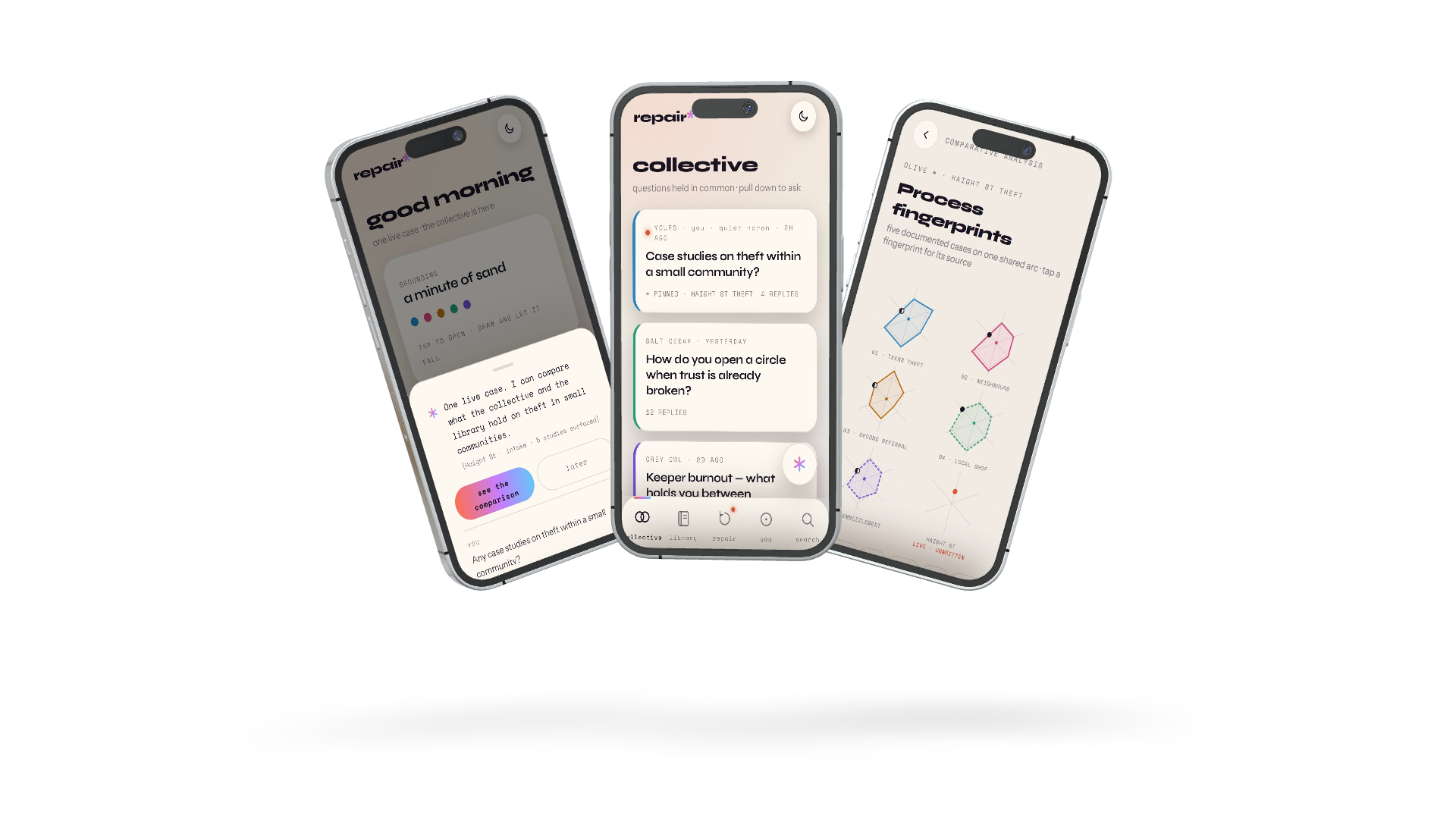
For client AI4: a collective-intelligence tool for restorative-justice facilitators, grounded in trauma-informed and positive-computing research. I led it 0→1, from org strategy to working prototype.
"Phase 2 incorporates leadership across both product and research cycles."
From the project's statement of work
From org strategy to product strategy
I started with org-strategy facilitation to surface priorities, then ran discovery, prototype testing, and research into trauma-informed HCI and positive computing - mapping how academic and user research could reinforce each other.
A strategy-to-prototype sprint, end-to-end
Phase two moved into making: product hypotheses, personas and day-in-the-life journeys, information architecture, wireframes, a brand brief and style guide, and funder-facing prototype screens, closed with dev specs for handoff. Olive, a democratically governed RAG model, became the product's knowledge layer.
Results
- Every layer of a 0→1 product: org strategy, research, UX, brand, prototype, dev specs
- Trauma-informed and positive-computing research, made practical
- Olive, a democratically governed RAG model, designed as the product's knowledge layer
- Funder-ready prototype and roadmap
Research turned into a working, trauma-informed product - technology in service of repair.